
Harmonica Observatory
Harmonica events, players and sheet music from around the world
A directory of the harmonica world that started in Taiwan and grew global: events, student clubs, ensembles, players, teaching studios, contest pieces and sheet-music sources. Public posts scattered across platforms and languages are gathered in one place, with the original text and links kept intact. The interface speaks 繁體中文, English, 日本語 and 한국어.
- 24-hour Stories wall — Instagram Stories from the harmonica scene
- Public event calendar — events worldwide and online in their original time zones, with Google Calendar and ICS feeds
- Source directory and score index — filter by country and region; contest pieces by school year and ensemble type
- Open submissions and data API — add or correct sources, plus an RSS feed and public API
Chumei Campus Events
One feed for campus events at NTHU and NYCU
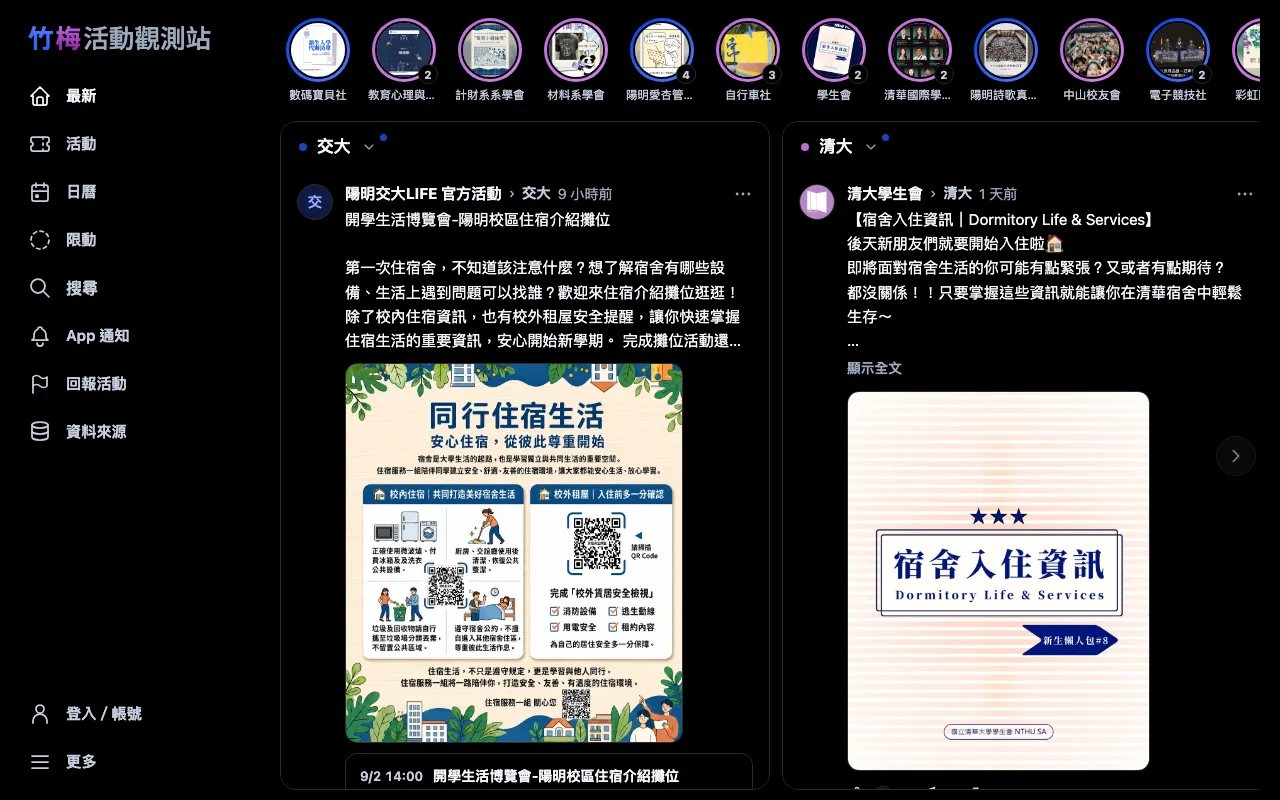
Collects public posts from clubs and offices at National Tsing Hua University and National Yang Ming Chiao Tung University — Instagram, Facebook, Threads, X and campus notices. An LLM pulls out each event’s name, time and place, and the result is a feed you can filter by campus, platform, event type and organizer.
- Event list and calendar — orientation, recruiting, performances and talks at a glance
- Stories wall — the last 24 hours of Instagram Stories from both schools’ clubs
- Subscribe anywhere — Telegram alerts, RSS and ICS calendars

Mayor 2026 Observatory
A timeline of what the mayoral candidates post
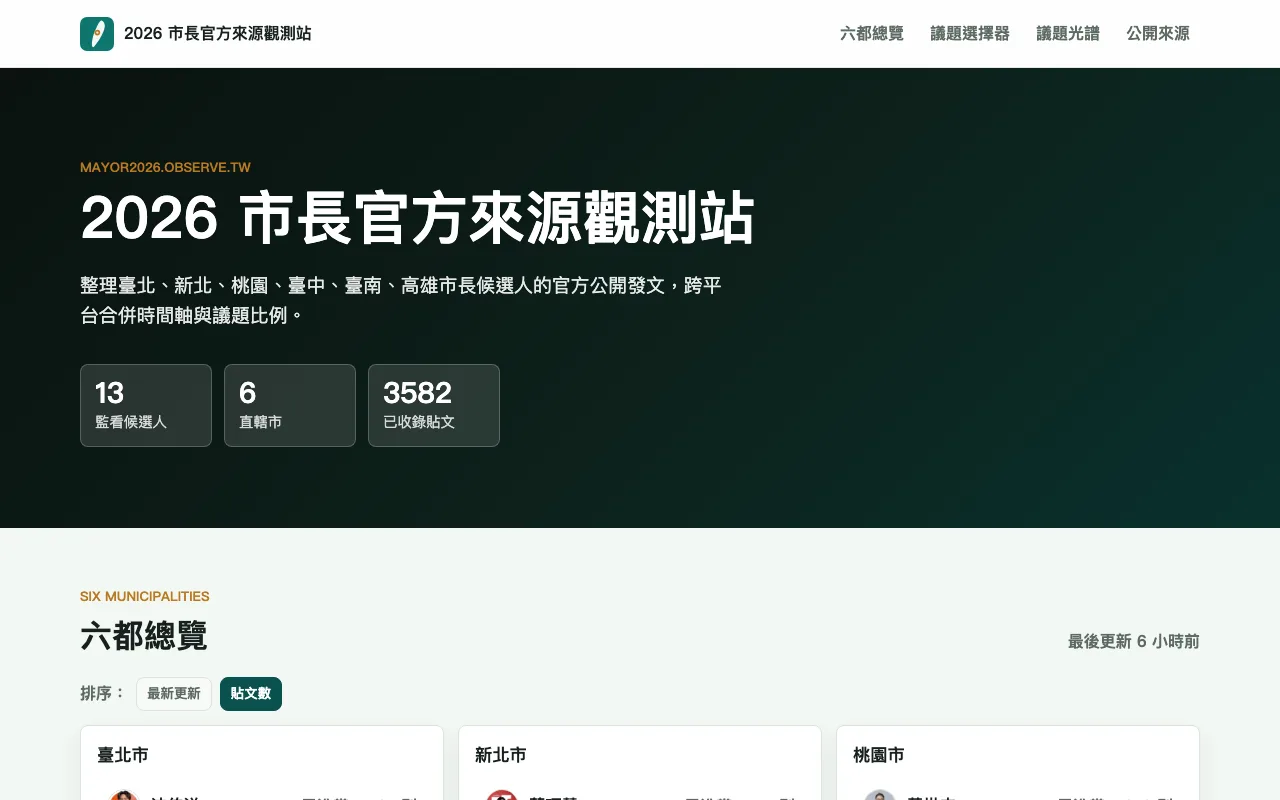
Collects the official public posts of mayoral candidates in Taiwan’s six special municipalities — Taipei, New Taipei, Taoyuan, Taichung, Tainan and Kaohsiung. It follows 13 candidates and more than 5,700 posts, merges every platform into one timeline, and classifies each post by issue.
- Six-city overview — candidates and posting volume, city by city
- Issue picker and spectrum — what each candidate talks about, and how much
- Original vs. reply — separates a candidate’s own posts from responses to others
News Tags
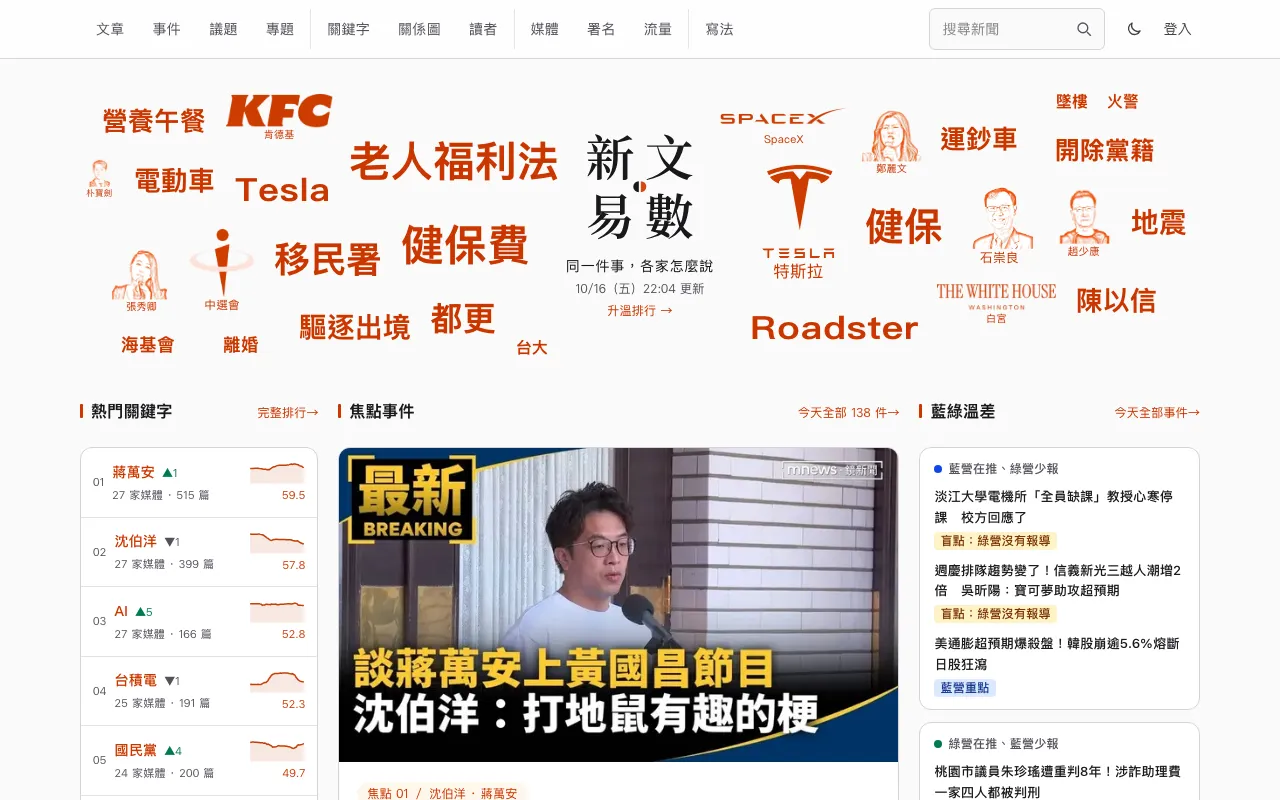
One story, every outlet’s headline
Crawls about 100 Taiwanese news outlets every 9 to 60 minutes and turns their tags, events and issues into data you can compare: the last 24 hours of coverage split by pan-blue and pan-green outlets, the issues heating up, and how each outlet headlines the same story.
- Headlines side by side — blue- and green-leaning headlines on the same political story
- Keyword ranking and events — tag scores and momentum; tags that spike together are grouped into events and archived hourly
- Open API and RSS — no key, CORS enabled, with an OpenAPI spec and event and tag feeds
Blog Watch
Every kind of life, each written its own way
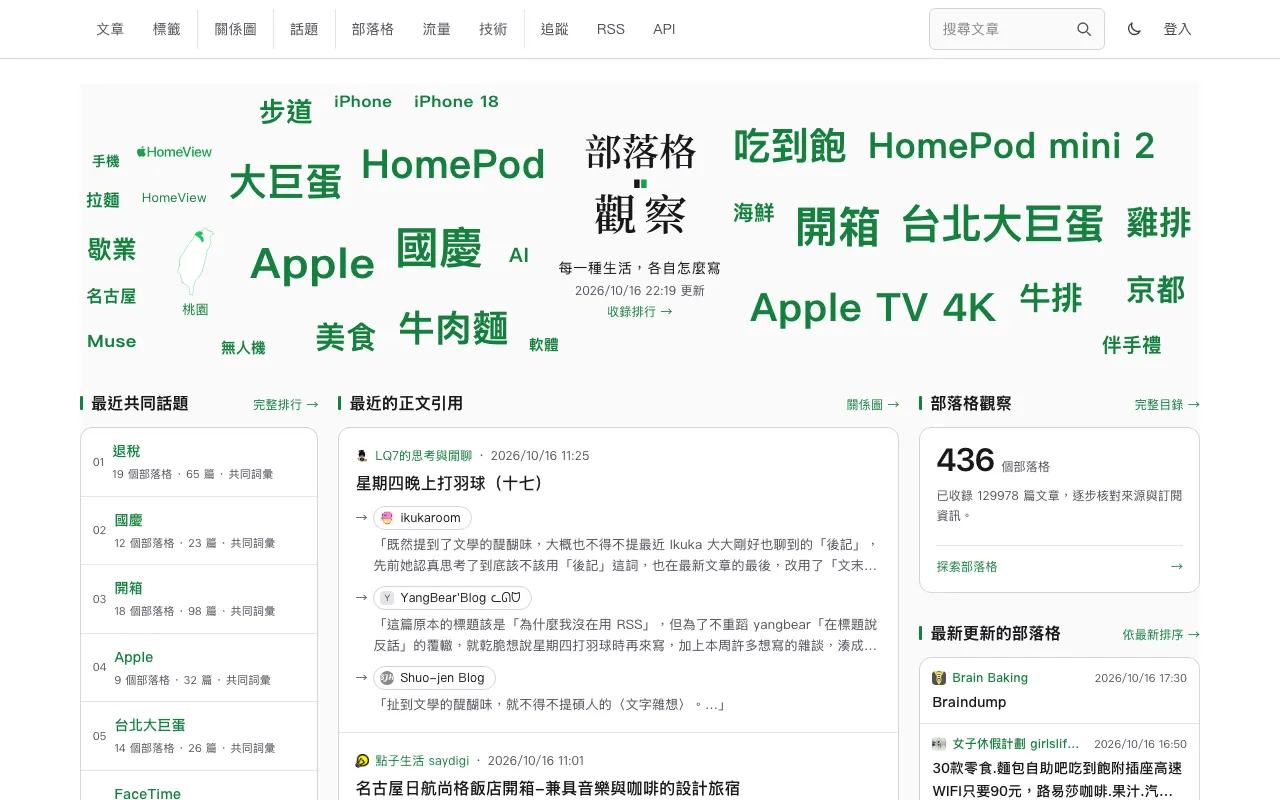
A sister site to tag.observe.tw that turns the same methods on Taiwan’s independent blogs: it collects more than 430 blogs and over 120,000 posts from their public RSS, Atom and sitemaps, then finds where blogs quote one another in their posts and which topics many of them are writing about right now.
- Citations and a link map — sentences from the last 90 days that mention another blog, drawn into one site-wide map
- Shared topics — words several blogs have taken up in the last 30 days, ranked by heat and how many blogs join in
- Follow and personal RSS — sign in to follow blogs, then export your own RSS feed and OPML
- Finds new blogs — weekly discovery; a candidate is added only once its feed and homepage check out

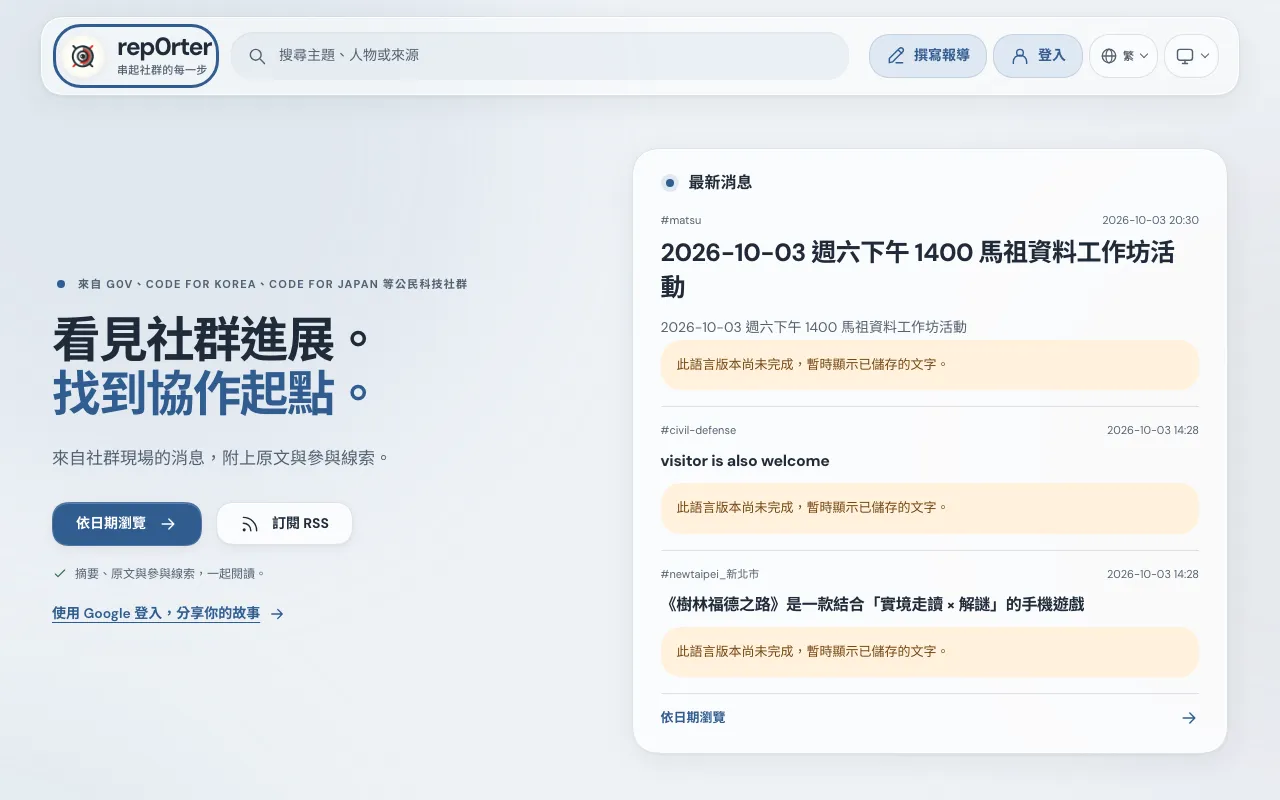
rep0rter
An AI reporter for the civic-tech community
Every hour it reads the public workspaces of civic-tech communities such as g0v, Code for Korea and Code for Japan — Slack, GitHub, Mastodon, RSS and public Notion — picks out the progress worth knowing about, and writes it up as short news stories.
- Four languages — 繁體中文, English, 日本語 and 한국어, each story with cards linking its sources
- Editorial rules — scoring and de-duplication; bots, CI noise and people who opt out are left out
- Published everywhere — the website, RSS, a Telegram channel and Threads
YouTube Board
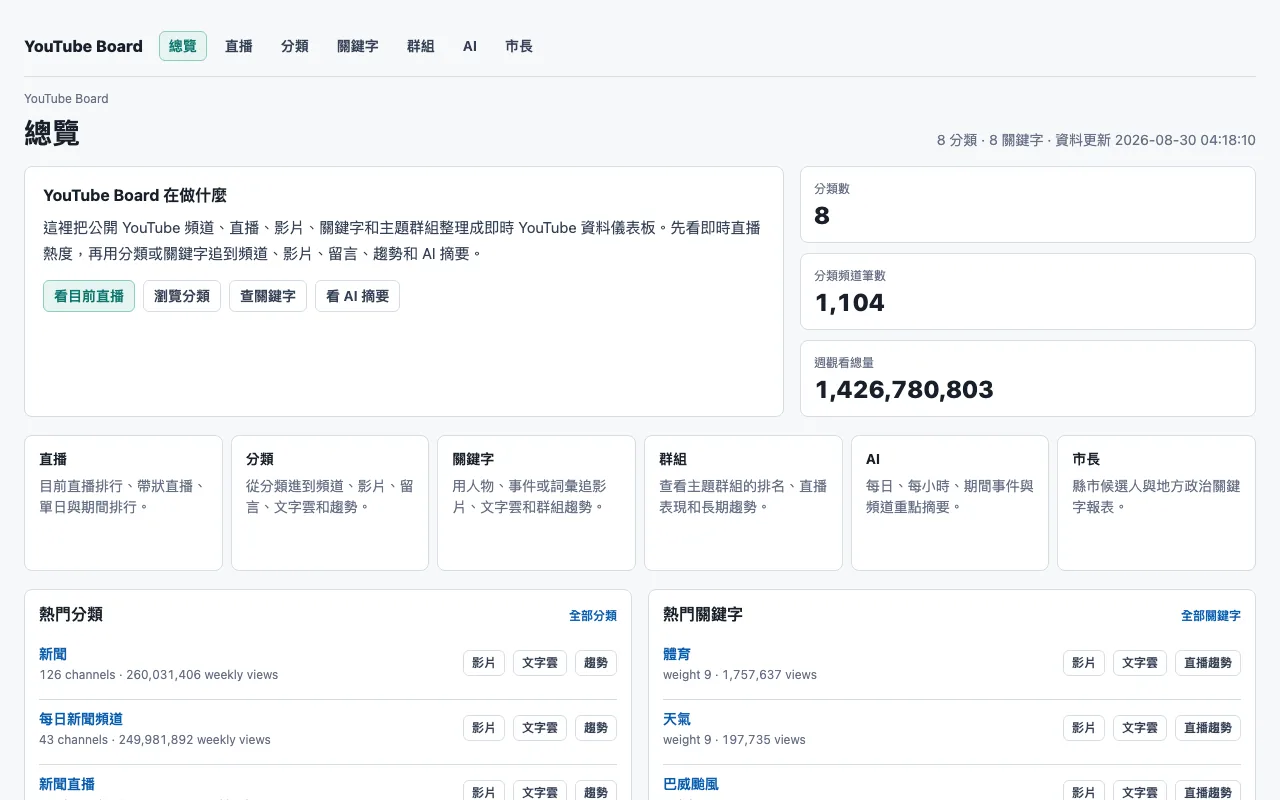
One story, every channel’s take
A live dashboard of more than 3,400 public YouTube channels and nearly 700,000 videos: what news, TV and political channels are streaming right now, which issues are heating up, and — by matching video titles against tag.observe.tw’s news tags — how each channel covers the same story.
- Live now and a video wall — current livestream rankings, concurrent viewers and many channels side by side
- Trending tags and word cloud — news tags from tag.observe.tw matched against video titles and descriptions, ranked by channel-weighted heat
- Issues and event timelines — AI-organized daily issues and how events unfold, with the cited videos to check against
- Election reports — candidates and local political keywords by city

urtube
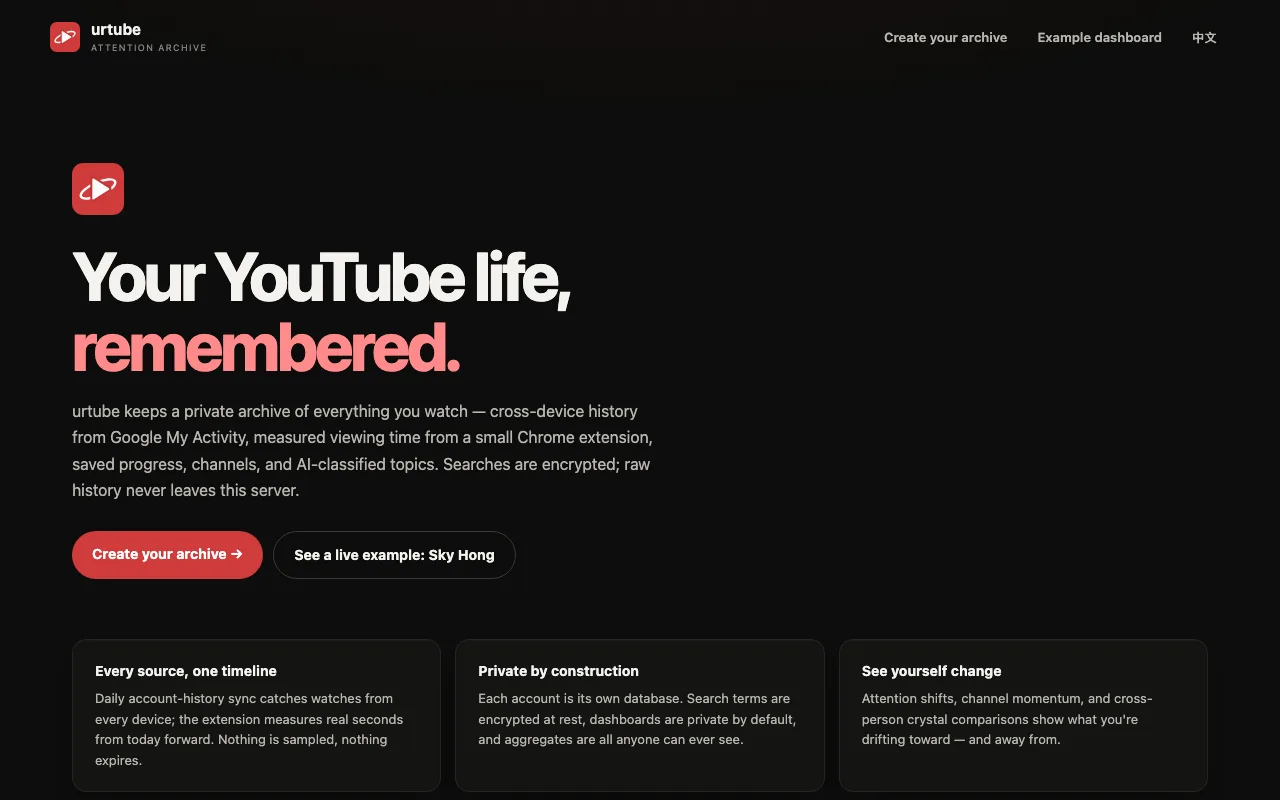
Your YouTube life, remembered
A private archive of your YouTube attention: it syncs cross-device watch history from Google My Activity every day, measures real watch time with a Chrome extension, and adds progress, channels and AI topic labels — so you can see where your attention goes over time.
- Every source, one timeline — nothing sampled, nothing expires
- Private by construction — a separate database per account, encrypted search terms, dashboards private by default
- Watch yourself change — attention shifts, channel momentum and comparisons with friends
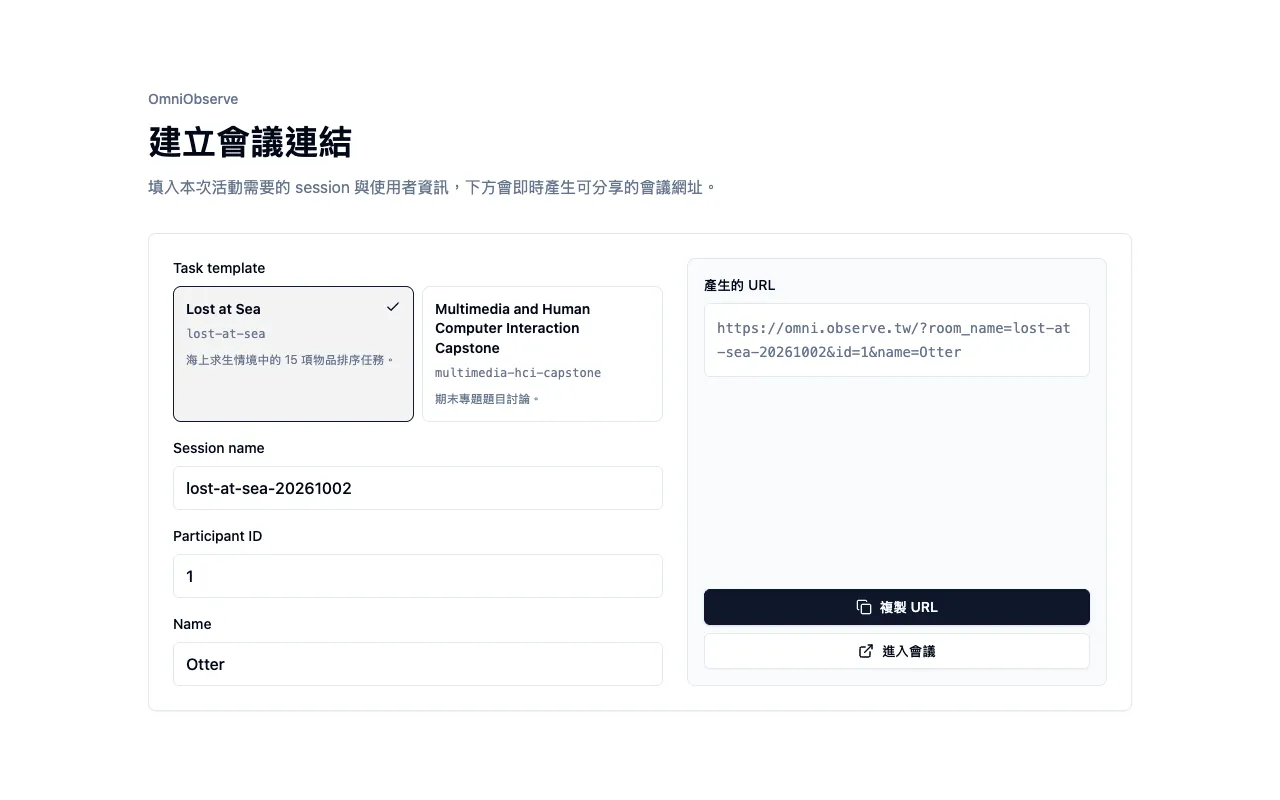
OmniObserve
Meeting facilitation that surfaces hidden agreement
A research platform from the HAIX lab at NYCU. Participants leave Idea Blocks through a private voice back channel; the system finds similar ideas nobody has said out loud yet across participants and nudges them anonymously, so latent agreement can surface in the open discussion.
- Front and back channel — video call, live transcription and private thoughts side by side
- Anonymous similarity nudges — learn that someone thinks like you, without revealing who or what
- Research tooling — task templates, a meeting-link generator and a researcher monitor
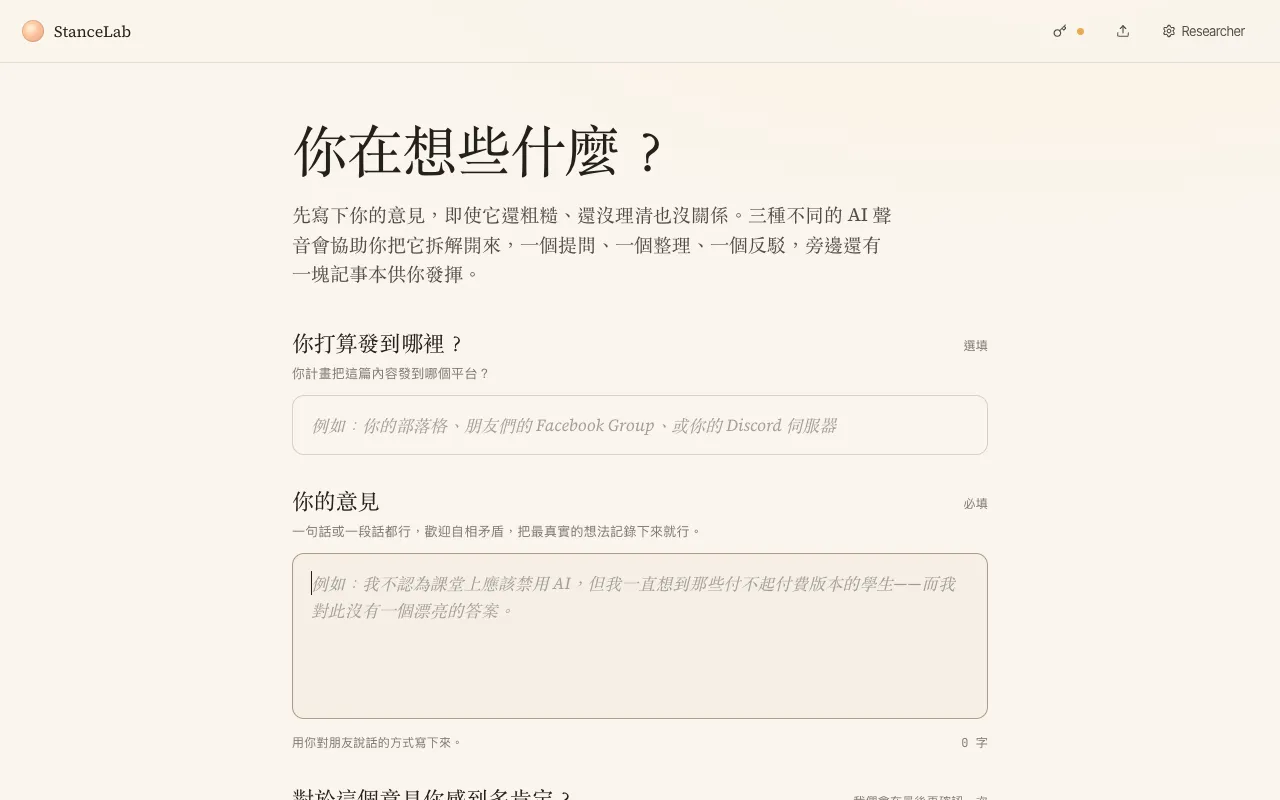
StanceLab
Turn a first reaction into a stance worth discussing
Write down a rough opinion and how sure you are, then take it apart with AI: an interviewer clarifies, a mentor organizes, a devil’s advocate pushes back. A notebook on the side collects useful fragments until it all comes together as a draft you can post.
- Three roles or one partner — compare a multi-role setup with a plain chatbot
- Bring your own key — OpenRouter or OpenCode Go, with a demo mode when you have none
- Export and resume — export the draft as text, or the whole session as JSON to import later

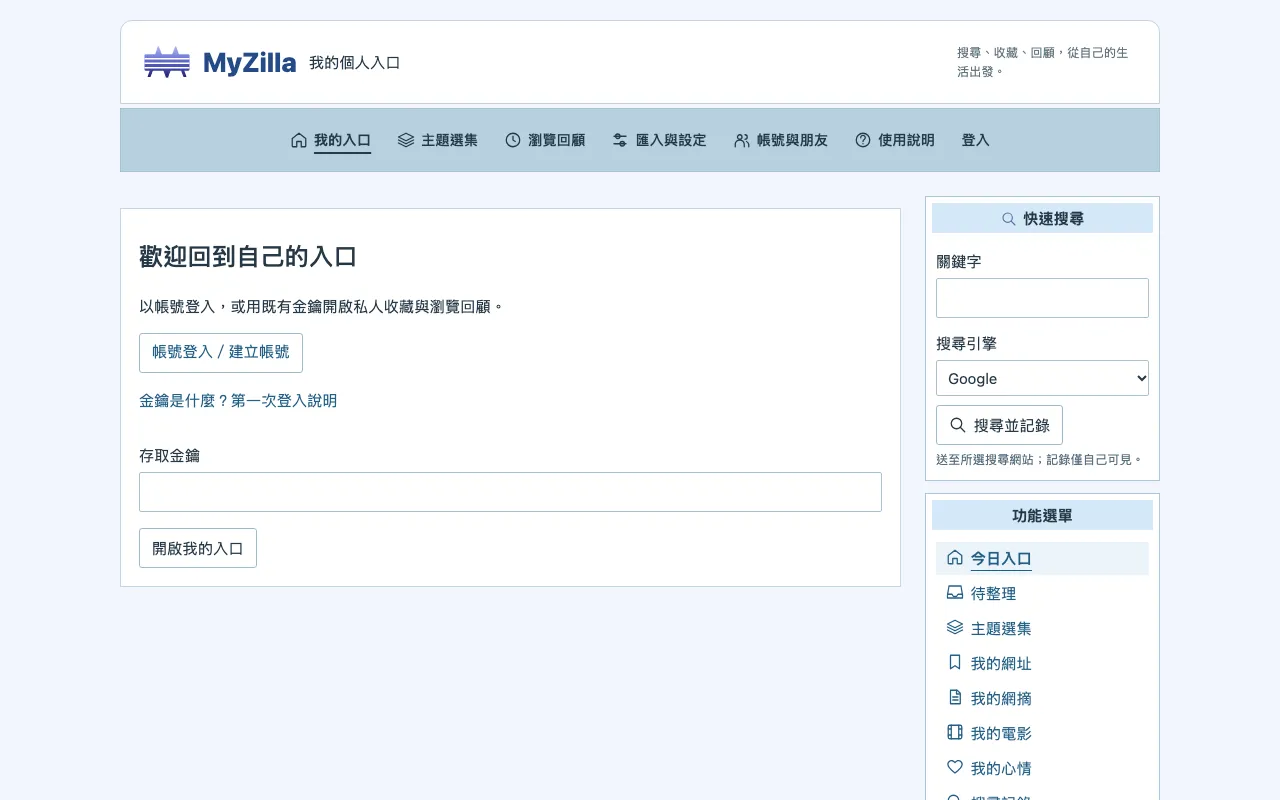
MyZilla
My personal portal · browsing in review
A remake of MyZilla, the 2000s personal portal — bookmarks, clippings, multi-site search, movies and moods — plus a full review of your browsing history. The raw history stays on my own server and is never published.
- Browsing review — top sites, full-text search over visits, and foreground time measured by the extension
- Insights and weekly AI review — an interest map and exploration paths, with the last 7 days summarized daily
- Accounts and friends — invite-only private accounts; interests are compared only when both sides agree

localplaud
A self-hosted pipeline for Plaud recordings
Keep using the Plaud recorder and its official upload, but run transcription, speaker diarization, summaries, search and Q&A on my own machines — the raw audio comes back through Plaud’s Open API, and everything derived from it stays with me.
- The full pipeline — transcode, transcribe, align, diarize and correct, then notes, chapters and mind maps
- Ask across recordings — question one recording or the whole library, with playable citations
- Runs on my hardware — deployed on the lab’s GPU host, with swappable local ASR and models
Private service · sign-in required
More projects
Not under observe.tw, but also things I’ve been building lately.

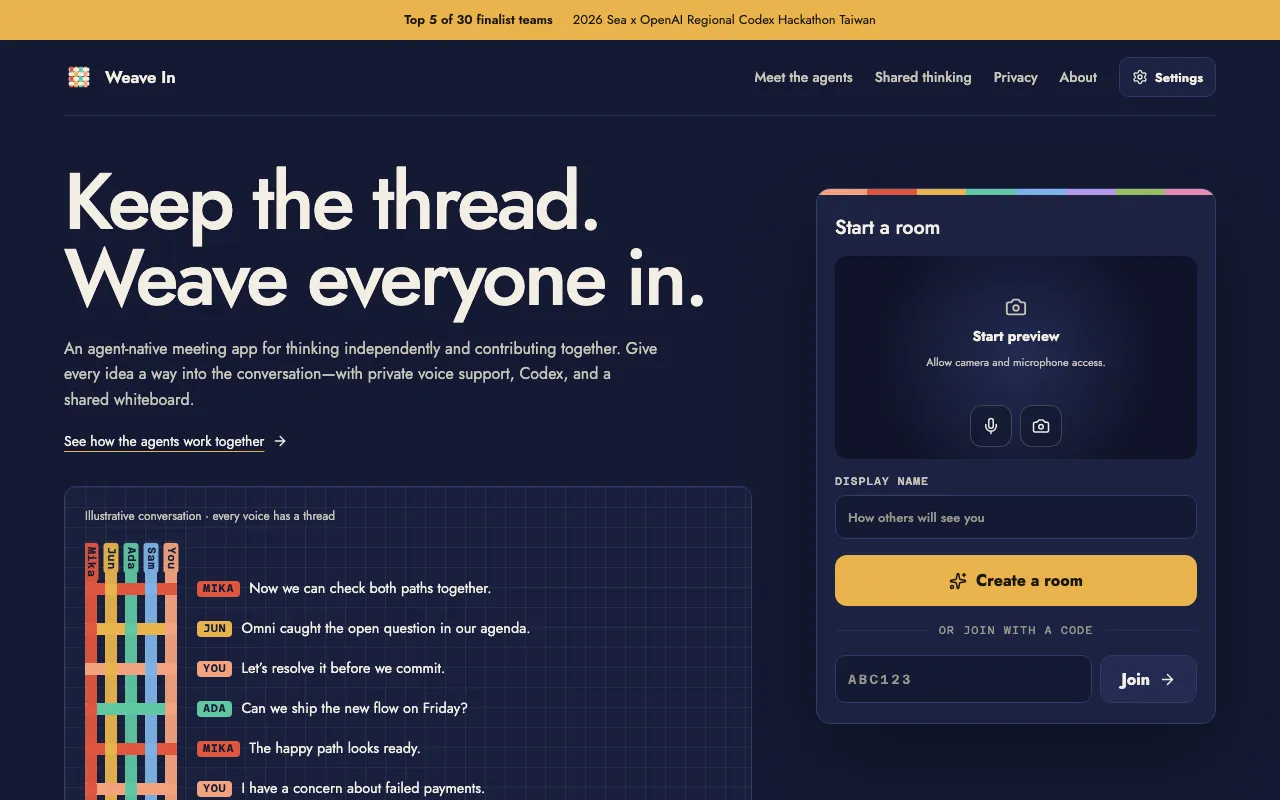
Weave In
Keep the thread. Weave everyone in.
Browser meetings that push back on groupthink: up to eight people share video, screens, live captions and a whiteboard, no account needed. Finalist at the 2026 Sea × OpenAI Codex Hackathon Taiwan (top 5 of 30).
- Muse — a private assistant for each person — type, dictate or talk in real time
- Omni — a shared facilitator that notices early convergence, drift or uneven airtime, and speaks only with consent
- WebMCP — outside agents such as Codex can read the meeting context and work the whiteboard
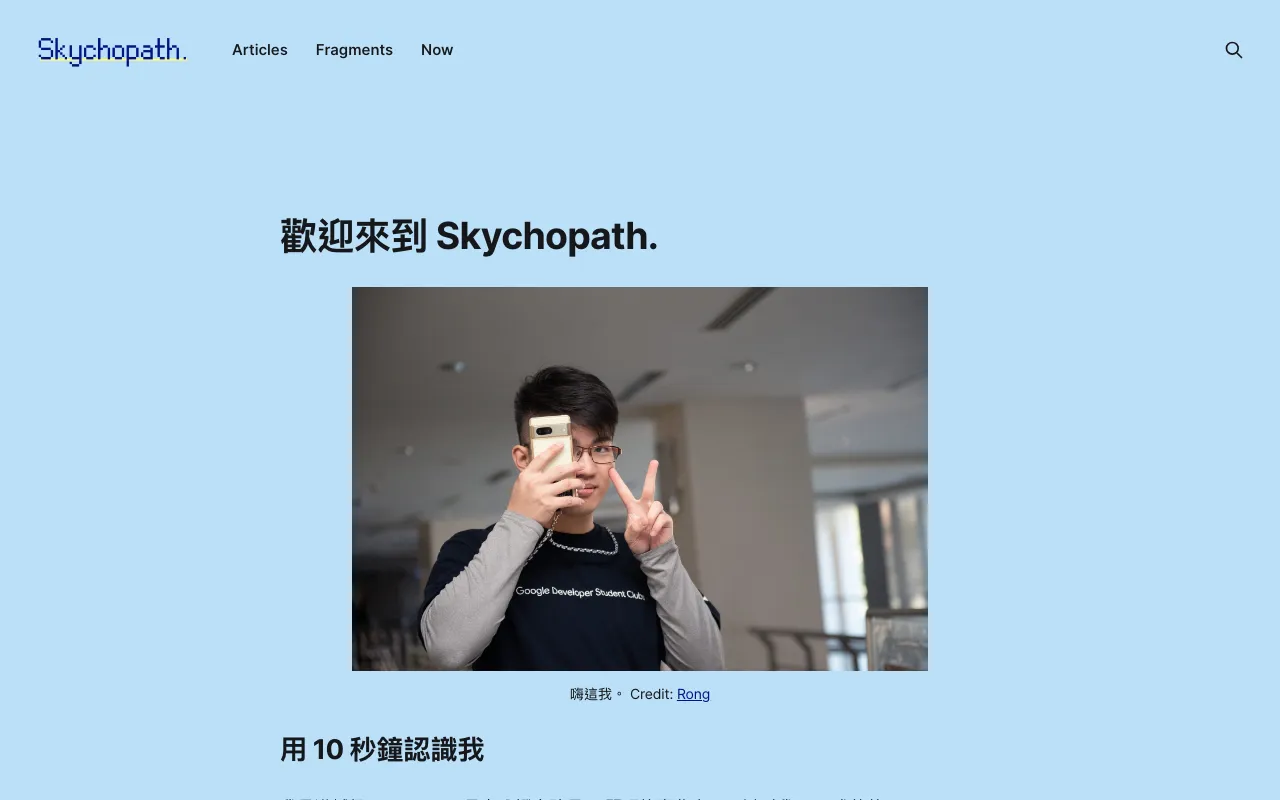
Skychopath.
Personal blog
Reflections, projects and whatever I’m obsessed with lately. Self-hosted Ghost with a theme maintained on top of the official Source theme; my changes live in separate partials and styles, so upstream updates merge cleanly.
- Articles — long-form reflections, project write-ups and notes
- Fragments — short pieces and passing thoughts
- Now — what I’m working on and thinking about right now

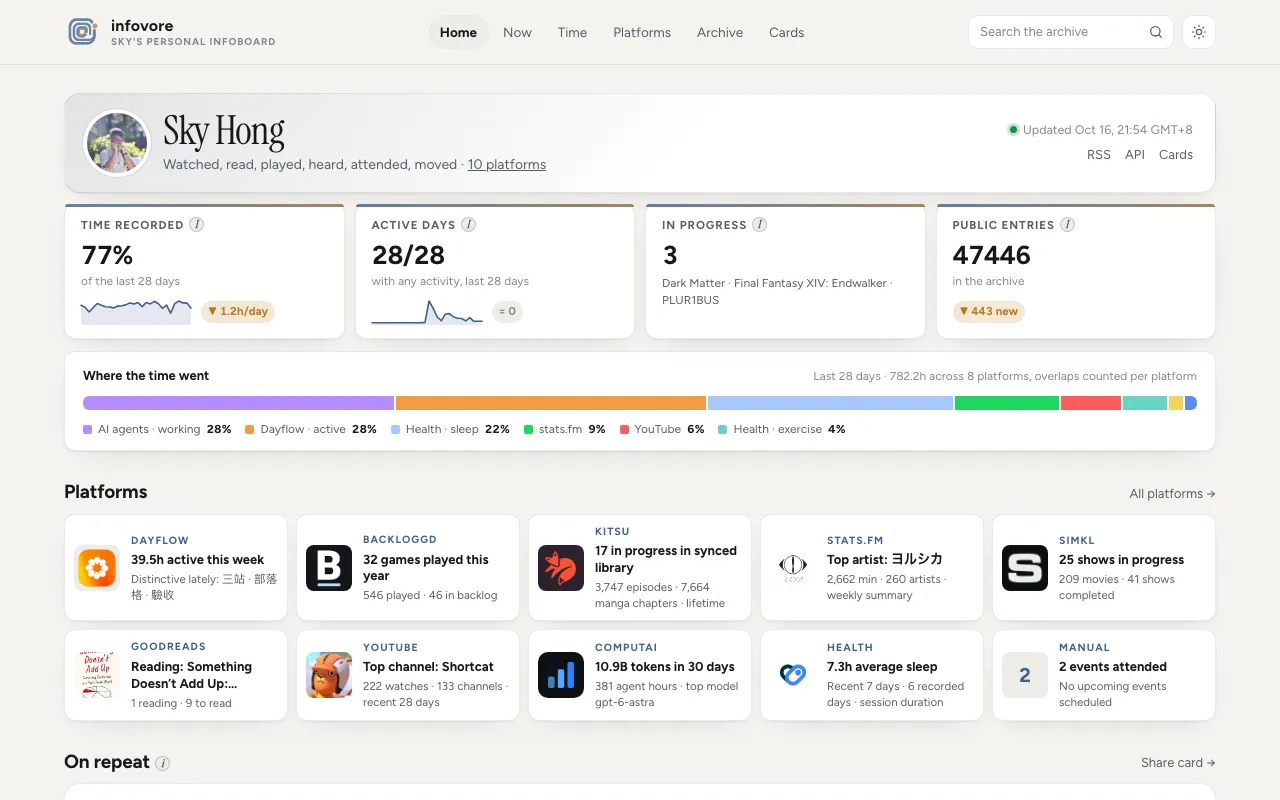
infovore
The rings of a life
Everything I play, watch, read, listen to and attend — from Backloggd, Kitsu, stats.fm, Simkl, Goodreads, YouTube and more — normalized into one dataset in SQLite, so an upstream outage never leaves the page blank.
- Public timeline — a de-duplicated activity log with RSS and a JSON API
- Status cards — SVG, PNG and WebP cards rendered live by Satori, ready to embed in a GitHub README
- Wrapped and MCP — a yearly recap, and an MCP endpoint AI tools can query

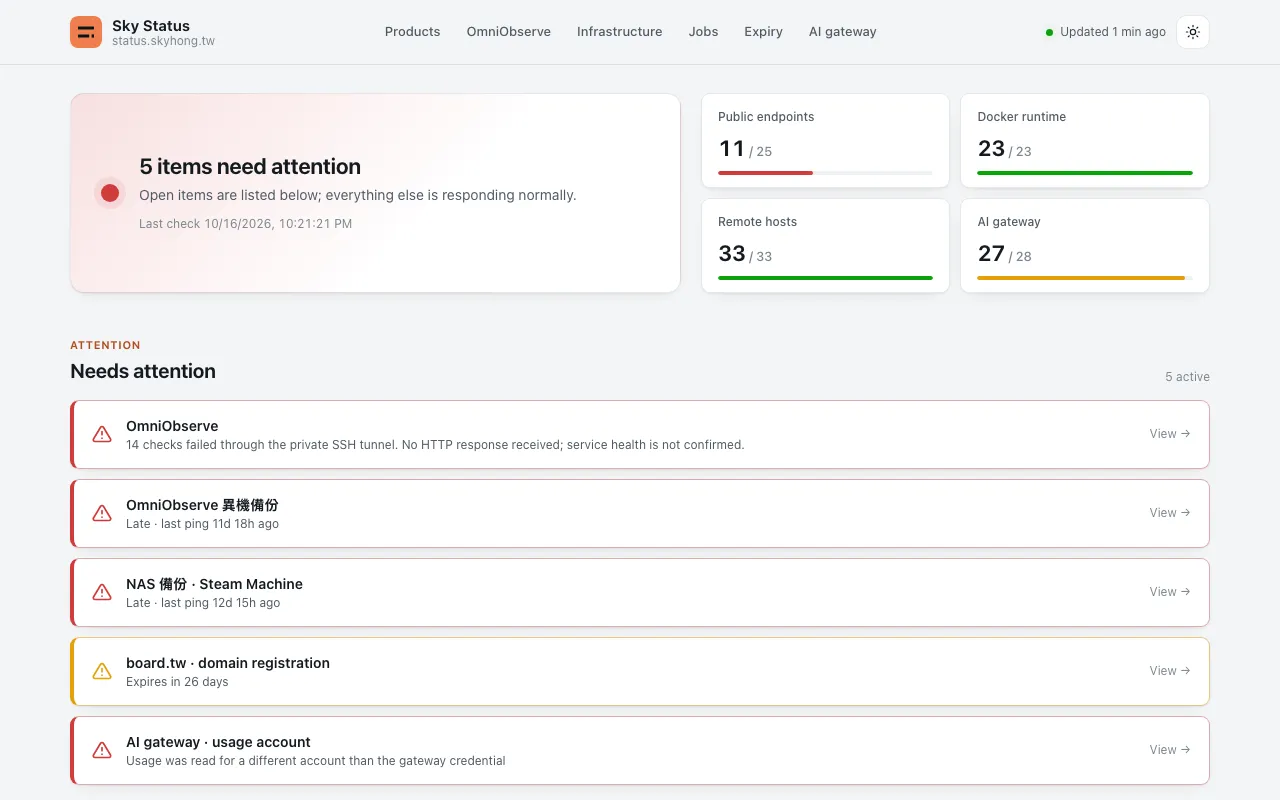
Sky Status
A public operations dashboard for my self-hosted services
Watches the public endpoints, Docker state and remote hosts behind everything I self-host, and keeps 90 days of availability history. Keys stay on the server and never reach the browser.
- Availability history — segmented uptime bars, response times and 7-, 30- and 90-day figures
- Expiry watch — TLS certificates and domain registrations (RDAP, with WHOIS for .tw)
- Alerts and usage — Discord down and recovery alerts, heartbeats, OpenAI usage and Prometheus metrics

Encore
A song-request system for the harmonica club’s booth
Built for the club fair booth: visitors scan a QR code to vote for songs, the big screen plays the music video, the speaker plays the backing track and an earpiece carries the original vocal as a guide — three streams in sync. It all runs on a phone hotspot’s local network, no internet needed.
- Three streams in sync — the backing track is the master clock, the video re-syncs every second, and the vocal guide has a ±500 ms offset
- Live requests — the audience votes from their phones; drop new files in and rescan
- Performer console — A–B loops and pitch-preserving slow-down, all on keyboard shortcuts
Runs on a local network · no public URL
This page is open source too: skyhong2002/observe.tw